(Case 02)
User research · Systems thinking · Advisory
Why don’t more mbo students start a business?
User research and systems analysis for ROC van Amsterdam: “The Missing Entrepreneur”. The advice was adopted into the curriculum.
Adopted in the curriculum Still in use
| Client | ROC van Amsterdam Zuidoost, Commerce & Entrepreneurship (mbo level 4) |
|---|---|
| Year | 2024 – 2025 |
| Type | User research · systems thinking · advisory |
| My role | Lead interviewer & transformation advisor, team of four |
| Methods | 8 in-depth interviews, thematic analysis, causal loop diagram, iceberg model, Cynefin, impact analysis |
(Challenge)
The missing entrepreneur
Ambition that rarely becomes a business.
- Young Dutch people who consider it
- 46%
- Who actually start
- 5%
- Missing entrepreneurs in the EU
- 7.5M
Many mbo students, often from diverse backgrounds, want to start a business, but few do (OECD & European Commission, 2023). ROC van Amsterdam wanted to know what holds them back and how education can help. We focused on Commerce & Entrepreneurship in Zuidoost, a new programme whose first cohort was in its second year.
(Context)
Why they are missing
Who we miss, and what it costs.
- Missing entrepreneurs in OECD countries
- 34.1M
- Young Dutch people who feel capable
- 40%
- Mbo graduates: the Netherlands isn’t set up for young founders
- >50%
Picture an entrepreneur and many people still see a white man in a suit, a stereotype deep in our culture (Ahl, 2006; OECD, 2021). The “missing entrepreneurs” are everyone outside that picture: women, young people and people with a migration background, who start a business far less often. The OECD and the European Commission estimate there are 7.5 million of them in the EU and 34.1 million across OECD countries (2023). Young people stand out most, compared with men aged 30 to 49, the most active and successful founders.
In the Netherlands, 46% of 15 to 30-year-olds consider starting a business and another 39% would rather work for themselves, yet only about 5% actually start. Part of the gap is confidence: only 40% of young people see themselves as capable enough (OECD, 2021). For mbo students it is sharper still. More than half of mbo graduates say the Netherlands isn’t set up for young entrepreneurs, with too little knowledge and too little support from schools, government and banks (Fonk, 2023). That is a loss, because mbo graduates keep society running.
Why it matters beyond one school
-
Innovation and diversity
People outside the usual picture bring new perspectives and ideas. Diversity in entrepreneurship leads to more innovation and makes economies more resilient to disruption (Alsos et al., 2013).
-
Inclusive growth
Using the full potential of a population spreads opportunity and wealth more fairly, a pillar of economic transformation (OECD, 2021).
-
New sectors and niches
Missing entrepreneurs often start in under-served areas, such as sustainable energy and social enterprise, and help new markets grow (Carree & Thurik, 2010).
Economic transformation is more than growth: it is a structural shift towards an economy that is more inclusive, more innovative and more sustainable (Mazzucato, 2018a, 2018b; Rodrik, 2013). In Kate Raworth’s doughnut, which she explained to us in person during the programme, that means an economy that stays within the planet’s limits while strengthening its social foundation (Raworth, 2017). You can’t get there while a large part of the population never gets the chance to build something of their own.
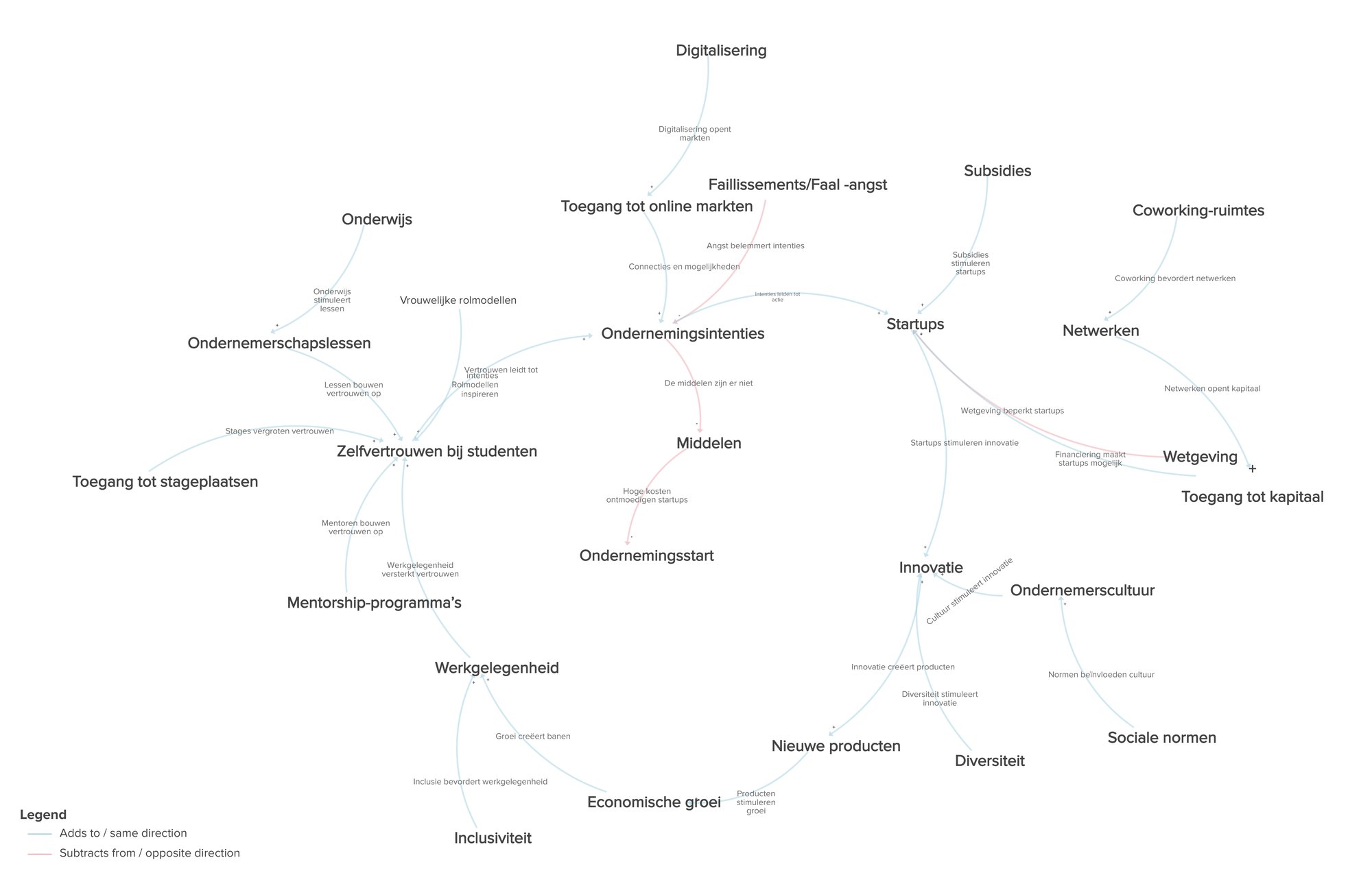
That is also why it is a wicked problem. The missing entrepreneur is tangled up with social inequality and limited economic opportunity, and every fix has side effects elsewhere (Termeer, Dewulf & Biesbroek, 2019). In the Cynefin framework it sits in the complex and chaotic domains, where there are no ready-made answers and you have to experiment (Snowden & Boone, 2007). Our causal loop diagram showed reinforcing loops in both directions: diversity creates new chances, while financial barriers and a lack of role models deepen inequality (Jalali & Beaulieu, 2023).
(Approach)
Theory first
Theory first, then the field.
Main question: how does entrepreneurship education influence the entrepreneurial intentions of mbo students at ROC van Amsterdam Zuidoost? Three sub-questions followed from it: how the school shapes its entrepreneurship education, how it motivates students’ intentions, and how students experience that education themselves.
-
Frame it as a system
Cynefin, a causal loop diagram, the iceberg model and a stakeholder analysis: from events to the structures and mental models underneath.
-
Let theory shape the questions
The Theory of Planned Behaviour (Ajzen, 1991): attitude, social norms and perceived control gave every interview question a purpose.
-
Talk to students and teachers
In-depth interviews with five randomly selected students and three teachers, recruited through teachers, anonymous and with consent.
-
Analyse
Transcribed and coded with a hybrid thematic analysis: codes from theory, plus themes from the interviews.
-
Translate to advice
An impact analysis (DRIFT, Small Wins, leverage points) showed what changes the system, not just the symptoms.
(My role)
Of the eight interviews, I conducted seven and transcribed and coded three. I visualised the system with Cynefin, the causal loop diagram and the iceberg model, wrote the impact analysis, and formulated the advice on network events. Afterwards I turned the findings into a podcast episode and an A2 poster.
(Stakeholders)
Different interests
Everyone wants something different.
-
Students
Want education that is accessible and motivating, where they build practical skills and confidence.
-
Teachers
Want to grow entrepreneurial skills, but have limited time and means, and some lack entrepreneurial experience themselves.
-
The school
Guards the general learning goals and the results of the programme.
-
Regional businesses
Need proactive, enterprising employees, but are sometimes wary of sharing knowledge or networks with future competitors.
-
O2Lab
The school’s innovation lab could lead the change, but depends on support and resources from the institution.
Background matters too. Gender, ethnicity and socio-economic status shape what students need and which doors are open to them, for example through fewer recognisable role models or a smaller network. The school already runs guest lessons, works with O2Lab and sets project assignments, but these stay separate pilots instead of becoming part of the system.
(Insights)
What students need
What students told us they need.
-
A network
Students rarely know anyone who started a business, and have few chances to meet entrepreneurs.
-
Personal guidance
Generic lessons are not enough; students miss support that fits their own plans.
-
Learning by doing
Plenty of theory, too few realistic simulations and practical assignments.
-
Feedback that leads somewhere
Students feel little is done with their feedback. Confidence grows when their input matters.
-
Role models like them
Students look for recognition: people from their own background who did it.
| Iceberg level | What we found |
|---|---|
| Events | Few mbo students, and especially few women, start a business. |
| Patterns | Young people rarely act on strong ambitions; confidence is lower among women and young people in mbo. |
| Structures | Entrepreneurship is not structurally supported in mbo; policy reaches universities more than mbo colleges. |
| Mental models | Stereotypes link risk-taking to men, and limit belief in the success of some groups of entrepreneurs. |
(Voices)
From the interviews
In their own words.
Anonymous quotes from the interviews, translated from Dutch. They are the reason behind each insight above.
Shared anonymously, with permission from the participants.
“Our class isn’t really close. There are some boys whose names I still don’t know, but they don’t always know mine either.”
“My friends and I don’t really talk about it. They’re busy with their own world, and we usually don’t talk about personal things like what we want to do. In class it doesn’t come up much either.”
“You learn faster and understand it better yourself. When you really have to run a business, you learn quicker what does and doesn’t work. Theory is nice, but in practice it’s really hard.”
“I’d really like to learn more about how to grow a business, from marketing to attracting customers. And how to stay financially healthy as a company.”
“I’m used to them not really responding well when they ask and I answer. Once I asked a teacher if she could talk a bit softer, and she got really angry. Then I thought: never mind.”
“We also have students who don’t have that network, who don’t come from an entrepreneurial family. That is one of the biggest obstacles that makes students drop out or lose motivation.”
(Outcome)
Advice in use
Advice the school actually used.
-
Feedback and co-creation
Anonymous exit tickets each semester, with clear feedback on what was done with them.
-
Guidance and practice
One-to-one coaching, small groups, company visits, prototyping and simulations.
-
Network events
Students meet entrepreneurs; alumni return as role models, guest teachers and coaches.
- The programme picked up the advice and adjusted its curriculum. The work is still in use.
- I was invited to speak to students, and asked to come and work at the programme.
Looking ahead. The future of entrepreneurship education is an entrepreneurial mindset: creativity, initiative and solution-focused thinking, built in structurally instead of in loose lessons. And with sustainability at the core, so students learn to create value that matters not only economically, but also socially and ecologically.

(Reflection)
What I learned
Presenting insights matters as much as finding them.
Turning complex models into clear visuals made the findings land with very different audiences. The podcast taught me that a catchy format is not enough: storytelling and one clear message matter just as much.
This was a single case study with five students from a first cohort, so the results cannot simply be generalised. Saying so made the advice more credible, not less.
“Standing in that classroom at ROCvA, talking with those young people, and seeing a light go on when they talk about what excites them.”
“Value isn’t always visible right away. It can be worth digging further, even when others doubt it.”
“Clear agreements and open communication matter most. One intervention isn’t enough; feedback needs a fixed moment.”
(Sources)
APA 7
References.
- Ahl, H. (2006). Why research on women entrepreneurs needs new directions. Entrepreneurship Theory and Practice, 30(5), 595–621. https://doi.org/10.1111/j.1540-6520.2006.00138.x
- Ajzen, I. (1991). The theory of planned behavior. Organizational Behavior and Human Decision Processes, 50(2), 179–211. https://doi.org/10.1016/0749-5978(91)90020-T
- Alsos, G. A., Carter, S., Ljunggren, E., & Welter, F. (Eds.). (2013). The handbook of research on entrepreneurship in agriculture and rural development. Edward Elgar.
- Carree, M. A., & Thurik, A. R. (2010). The impact of entrepreneurship on economic growth. In Z. J. Acs & D. B. Audretsch (Eds.), Handbook of entrepreneurship research (pp. 557–594). Springer.
- Fonk. (2023, September 4). Economisch: Obstakels voor jongvolwassenen met ondernemingsdromen. Fonk Magazine. https://fonkmagazine.nl/artikelen/economisch/obstakels-voor-jongvolwassenen-met-ondernemingsdromen-64885.html
- Jalali, M. S., & Beaulieu, E. (2023). Strengthening a weak link: Transparency of causal loop diagrams—Current state and recommendations. System Dynamics Review. https://doi.org/10.1002/sdr.1753
- Mazzucato, M. (2018a). The entrepreneurial state: Debunking public vs. private sector myths. Penguin Books.
- Mazzucato, M. (2018b). The value of everything: Making and taking in the global economy. Penguin.
- OECD. (2021). The missing entrepreneurs 2021: Policies for inclusive entrepreneurship. OECD Publishing. https://doi.org/10.1787/71b7a9bb-en
- OECD & European Commission. (2023). The missing entrepreneurs 2023: Policies for inclusive entrepreneurship and self-employment. OECD Publishing. https://doi.org/10.1787/230efc78-en
- Raworth, K. (2017). Doughnut economics: Seven ways to think like a 21st-century economist. Chelsea Green Publishing.
- Rodrik, D. (2013). The past, present, and future of economic growth (Global Citizen Foundation Working Paper No. 1). Global Citizen Foundation.
- Snowden, D. J., & Boone, M. E. (2007). A leader’s framework for decision making. Harvard Business Review, 85(11), 68–76.
- Termeer, C. J. A. M., Dewulf, A., & Biesbroek, R. (2019). A critical assessment of the wicked problem concept: Relevance and usefulness for policy science and practice. Policy and Society, 38(2), 167–179. https://doi.org/10.1080/14494035.2019.1617971