Untangling a wicked problem: drug crime in Amsterdam
A causal loop diagram and stakeholder map of a problem nobody owns. A smaller group project.
- Problem
- Drug crime in Amsterdam touches violence, money laundering and young people drawn into criminal networks, and nobody owns the whole problem.
- My role
- Systems mapper. I led the causal loop diagram and wrote an analysis of interventions.
- Team and time
- Team of four · 2024
- Delivered
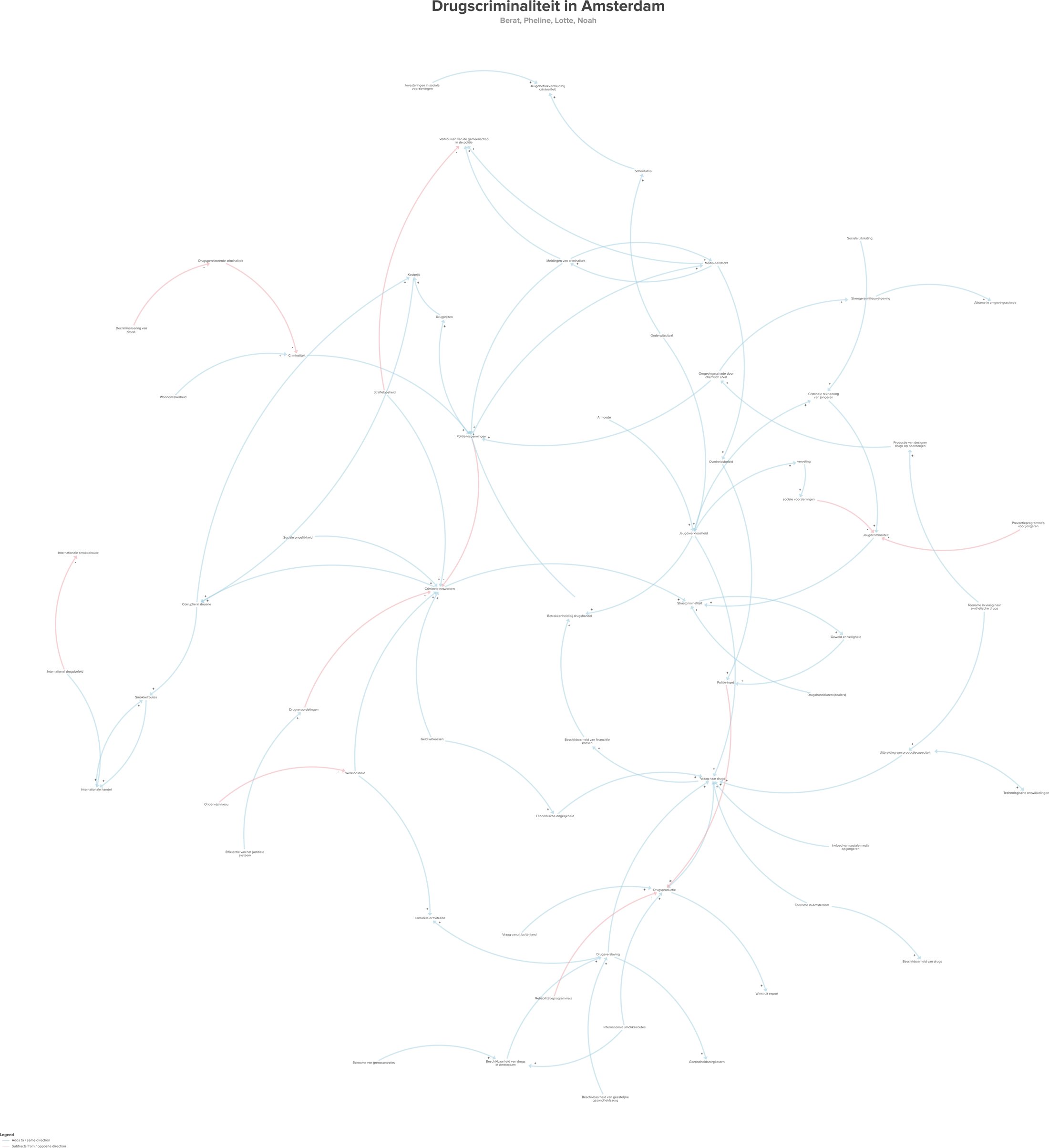
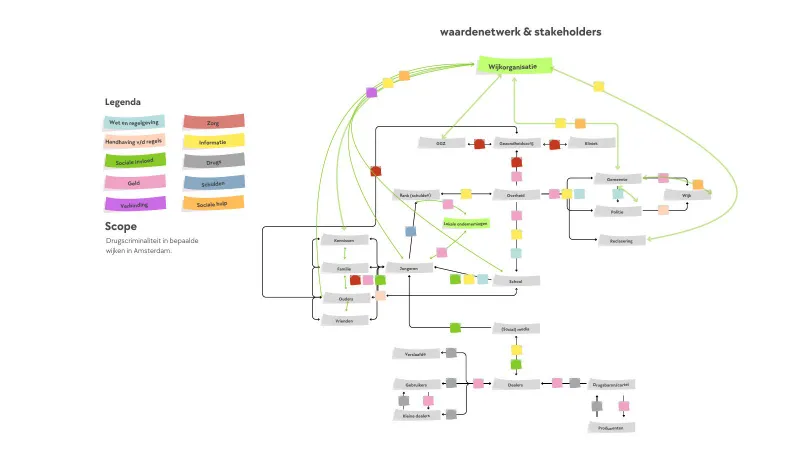
- A one-page framing, a value network and stakeholder map, and a causal loop diagram with more than sixty relations.
| Client | Amsterdam University of Applied Sciences |
|---|---|
| Year | 2024 |
| Type | Systems thinking · stakeholder perspectives · visual analysis |
| Methods | One-page framing, value network map, cause-and-effect analysis, causal loop diagram (Kumu, four versions) |
A textbook wicked problem.
- Amsterdam youth at risk
- 6.5%
- Nationally
- 5%
- Young Amsterdammers at risk
- 10,000
Amsterdam is an international hub in the cocaine trade, and drug crime touches almost everything: violence, money laundering through real estate, chemical waste, and young people drawn into criminal networks, sometimes from the age of twelve.
Residents, police, the City, youth workers, users and dealers disagree about what the problem even is. Some want tougher enforcement, others regulation. Every intervention has side effects elsewhere. We scoped it to specific neighbourhoods, and to why young people get involved.
It is wicked in five ways (Alford & Head, 2017). It is complex: criminal organisations, government, police and society are all involved, across legal, social, economic and environmental domains. It is interwoven: criminal networks run through the legal economy, and in some circles drug use has become normal. It is uncertain: regulation, tougher sentences and awareness campaigns each have benefits and risks, and nobody can say which works best in the long run. The views conflict: strict enforcement for some, regulation or even legalisation for others. And it causes social and planetary harm: chemical waste, and deeper inequality.
The City does a lot, from disrupting networks to prevention, but mainly at the level of symptoms. Money is the entry point: young people get involved because they need it, often because of debts. And doors close: discrimination on the labour market lowers the threshold to crime with every rejection.
The leverage sits at the root. Local opportunities and fair pay make legal work more attractive, and schools, youth workers and police can spot risks earlier together.
Start at the roots.
Young people often earn more in crime than in a regular job (Schouten & Bomers, 2022), and young people with a bicultural background find work harder to get, with or without a diploma (Van Doorn, 2021). Every rejection lowers the threshold. So I looked for interventions through the lens of new economic thinking.
-
Change the regime
Multi-level perspective: the current regime is held up by established criminal networks and social inequality. Better cooperation between government services, schools and police can spot vulnerable young people early and guide them.
-
Grow the niches
Small community initiatives that offer young people another perspective, such as education and work projects, can grow into the new normal.
-
Strengthen the social foundation
Doughnut economics: invest in education, housing and above all work for young people at risk, within the limits of the planet (Raworth, 2017).
-
Pay fairly, hire locally
Support local entrepreneurs so they can hire these young people, and pay at least the minimum wage, also to younger workers. Fair pay makes legal work more attractive than fast money, and keeps money and cohesion in the neighbourhood.
Never accept the first framing.
Map who sees a problem differently, and look for the structures behind the events. This project laid the foundation for the systems methods I used in every project after it.
It also held up a mirror. In this group I sometimes shared my opinion too quickly. The feedback made me change my approach: listen first, weigh the information, then take a position.
Read the full researchContext, approach and sources.
Mopping with the tap open.
Amsterdam's mayor speaks of "worrying signals" and a threat of "disruption of public life" (Tops & Tromp, 2019). The City, police and the public prosecutor work together in a joint approach against drug crime, along three lines (Driehoek Amsterdam-Amstelland, 2024). On money: fight criminal business and the people who facilitate it, such as those who help launder money. On violence: disrupt criminal networks and reduce weapons. On neighbourhoods: protect and strengthen residents, break criminal careers early, and reinforce the local approach.
On prevention there is a lot too: drug testing stations, information sessions for first- and second-year mbo students, Credible Messengers who use their own past to inspire young people to make other choices, neighbourhood justice in Zuidoost, street colleges where people with lived experience talk with young people, and sport as a way in (Driehoek Amsterdam-Amstelland, 2024).
It partly works. But the City's own report calls it mopping with the tap open, and the mayor started a debate on whether the war on drugs can be won at all. Our value network map showed something the approach hardly touched yet: young people get involved because of debts (Driessen & Koerntjes, 2023; Odekerken, 2024).
From one page to a system map.
-
Frame it on one page
What is the problem, for whom, and why is it wicked?
-
Map the value network
Money, debts, information, care, enforcement and social influence between young people and everyone around them.
-
Causes and effects
From the cocaine trade and poverty to weak cooperation between schools, youth workers and police.
-
Build the causal loop diagram
Four versions in Kumu, more than sixty relations, reinforcing and balancing.
-
Look for leverage
What the City already does, compared with what the map shows.
References.
- Alford, J., & Head, B. W. (2017). Wicked and less wicked problems: A typology and a contingency framework. Policy and Society, 36(3), 397–413. https://doi.org/10.1080/14494035.2017.1361634
- Driehoek Amsterdam-Amstelland. (2024). Rapportage Driehoek tegen Drugscriminaliteit: Visie en voortgang. https://openresearch.amsterdam/image/2024/5/14/driehoek_tegen_drugscriminaliteit_visie_en_voortgang.pdf
- Driessen, Z., & Koerntjes, D. (2023, December 3). Onderscheidende kenmerken van jonge drugsverdachten. Centraal Bureau voor de Statistiek. https://www.cbs.nl/nl-nl/longread/statistische-trends/2023/onderscheidende-kenmerken-van-jonge-drugsverdachten
- Odekerken, M. (2024, September 6). Jongeren, schulden en criminaliteit. Verwey-Jonker Instituut. https://www.verwey-jonker.nl/artikel/jongeren-schulden-en-criminaliteit/
- Raworth, K. (2017). Doughnut economics: Seven ways to think like a 21st-century economist. Chelsea Green Publishing.
- Schouten, D., & Bomers, L. (2022, July 19). Geld, geweld en geheimen: Om deze redenen komen jongeren volgens criminoloog moeilijk uit drugscriminaliteit. EenVandaag. https://eenvandaag.avrotros.nl/item/geld-geweld-en-geheimen-om-deze-redenen-komen-jongeren-volgens-criminoloog-moeilijk-uit-drugscriminaliteit/
- Tops, P., & Tromp, J. (2019). De achterkant van Amsterdam: Een verkenning van drugsgerelateerde criminaliteit. Gemeente Amsterdam. https://openresearch.amsterdam/nl/page/49334/de-achterkant-van-amsterdam
- Van Doorn, R. (2021). Migranten komen na het hoger onderwijs moeilijker aan de juiste baan. ScienceGuide. https://www.scienceguide.nl/2021/08/migranten-komen-na-het-hoger-onderwijs-moeilijker-aan-de-juiste-baan/