(Case 01)
Service design · Co-creation · Facilitation
Peer learning that people actually show up for
A peer learning format for the Living Labs of the Amsterdam Donut Coalition, from the first interviews to a format that is still in use.
Still in use Shared with Doughnut Economics Action Lab
| Client | Amsterdam Donut Coalitie (ADC) |
|---|---|
| Year | 2025 |
| Type | Service design · co-creation · facilitation |
| My role | Designer of the format and lead facilitator, team of four (Amsterdam University of Applied Sciences) |
| Methods | Interviews, stakeholder analysis, Cynefin, design principles, facilitation, 16-question survey, client evaluation |
(Challenge)
Knowledge sharing
Knowledge sharing that felt non-committal.
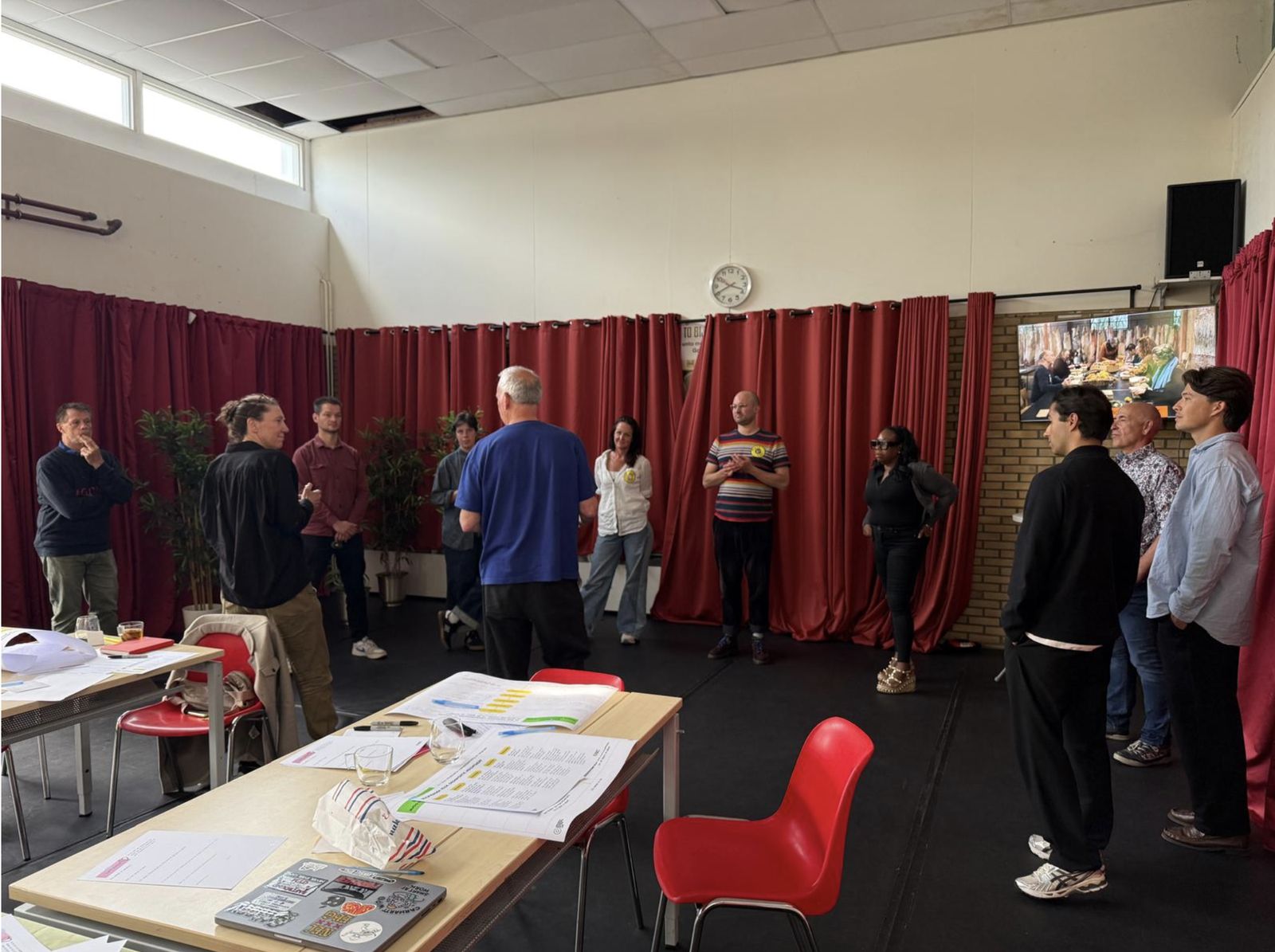
The Amsterdam Donut Coalition is a network of initiatives working on a fair and sustainable city. Its Living Labs were meant to become the place where pioneers, policy makers and the City of Amsterdam learn from each other. When we started, the labs only existed on paper.
Earlier research showed why that mattered. Many initiatives got stuck in the experimental phase, and sectors such as food, fashion and housing worked in silos. Pioneers felt their practical knowledge was not taken seriously; the City, which funds the programme, wanted measurable results. The ADC sat in between.
“What does peer learning need to look like so that it leads to meaningful knowledge sharing and lasting collaboration?”
(Context)
Why it stalled
Stuck in the experimental phase.
The Amsterdam Donut Coalition, founded in 2020, is an open network of people and organisations that put doughnut economics into practice: an economy that meets everyone’s basic needs while staying within the limits of the planet (Raworth, 2017). It works with Doughnut Economics Action Lab, Kate Raworth’s organisation, and connects bottom-up initiatives with the City of Amsterdam, which has embraced the doughnut as its model.
Its initiatives work at three scales: micro (small neighbourhood initiatives and social enterprises), meso (networks that support them) and macro (large policy programmes for system change), in three sectors: food and agriculture, fashion and textiles, and housing and development. After the first years of meet-ups, many initiatives were ready for the next step: lasting organisations and more impact. The meet-ups no longer fitted. In 2023 the City funded the coalition to strengthen community learning through Living Labs.
The same gap at three levels (Schuurman, 2015)
-
Operational · micro
Projects repeat each other’s mistakes and use resources inefficiently, because little is learned from earlier initiatives.
-
Organisational · meso
Cooperation between sectors stays limited, so promising solutions never get past the experimental phase.
-
Policy · macro
Policy makers and funders can’t see which initiatives really have impact, so subsidies are not used where they work and successes are not scaled up.
In the Cynefin framework this sits in the complex domain: cause and effect only become clear in hindsight, and there is no standard solution (Snowden & Boone, 2007). Underneath the visible events lie patterns of fragmented ways of working, and deeper still, sectors that hold on to their own methods without learning from each other. Little systematic reflection happens on why some initiatives succeed and others don’t, so learning cycles hardly start (Kolb, 2014; Mulgan, 2019).
Peer learning offered a way through: meetings where initiatives exchange experience in an accessible way, where everyone brings something and takes something home, which makes it more equal (Boud, Cohen & Sampson, 2014). Living Labs, as open innovation networks, are a natural setting to try it (Leminen, Westerlund & Nyström, 2012).
(Theory)
Why peer learning
Learning from and with each other.
Peer learning means people at a similar level exchange knowledge, experience and insight: colleagues, fellow students, other professionals (Boud, Cohen & Sampson, 2014). Where traditional learning mostly sends knowledge one way, peer learning is about equality and working together: exploring ideas, sharing examples and learning from each other’s successes and setbacks (Wenger, 1998). Discussing experience deepens understanding, sharpens critical thinking and raises motivation, because learning becomes a shared responsibility (Nonaka & Takeuchi, 1995).
Living Labs are experimental environments where users, researchers, businesses and policy makers develop, test and improve solutions together in a real context (Bergvall-Kåreborn et al., 2009; Schuurman, 2015). Iterative learning is at their core: knowledge grows through experiments and is shared, so practice keeps improving (Leminen, Westerlund & Nyström, 2012). Peer learning fits that perfectly. It can break the divide between micro, meso and macro initiatives, because experiences from different stages of development meet (Schuurman, 2015).
Pioneers play a key role. They introduce new ideas, challenge existing frameworks and connect researchers, policy makers and practice (Mulgan, 2019; Ståhlbröst & Holst, 2012). Knowledge from an experiment often stays inside it; pioneers carry it further by actively sharing what works, the way communities of practice pass on knowledge through informal networks and shared experience (Wenger, 1998).
What worked elsewhere
-
Learning pathways
In the KLIMAP research, participants learned from each other through fixed learning pathways with co-creation, joint reflection and feedback. Repeating the structure created a continuous learning process (Bhatta, Vreugdenhil & Slinger, 2025).
-
A safe, informal setting
In the HSB Living Lab in Sweden, residents, students and companies learned from each other in joint workshops. Feeling safe, equal and trusted made people share (Hagy, Morrison & Elfstrand, 2016).
-
The conditions
Peer learning doesn’t happen by itself. It needs equality between participants, a clear structure with fixed moments for reflection, a safe learning environment and a way to keep what is learned.
(Approach)
Six steps
From interviews to a tested format.
Four sub-questions guided the research: which forms of peer learning are feasible in the Living Labs, what role the coalition can play in facilitating them, how initiatives experience knowledge sharing and collaboration now, and how what is learned can feed into policy. We held six semi-structured interviews with pioneers across the micro, meso and macro levels, plus one expert interview, and analysed them thematically, building on communities of practice (Wenger, 1998), experiential learning (Kolb, 2014) and psychological safety (Edmondson, 1999).
-
Understand the system
Interviews with pioneers and an expert showed why knowledge sharing stalled: no shared learning process, unclear ownership, different ideas of “impactful learning”.
-
Set design principles
Psychological safety first, a low threshold, personal before professional, and every exercise ends in a concrete takeaway.
Kolb (2014) · Wenger (1998) · Edmondson (1999)
-
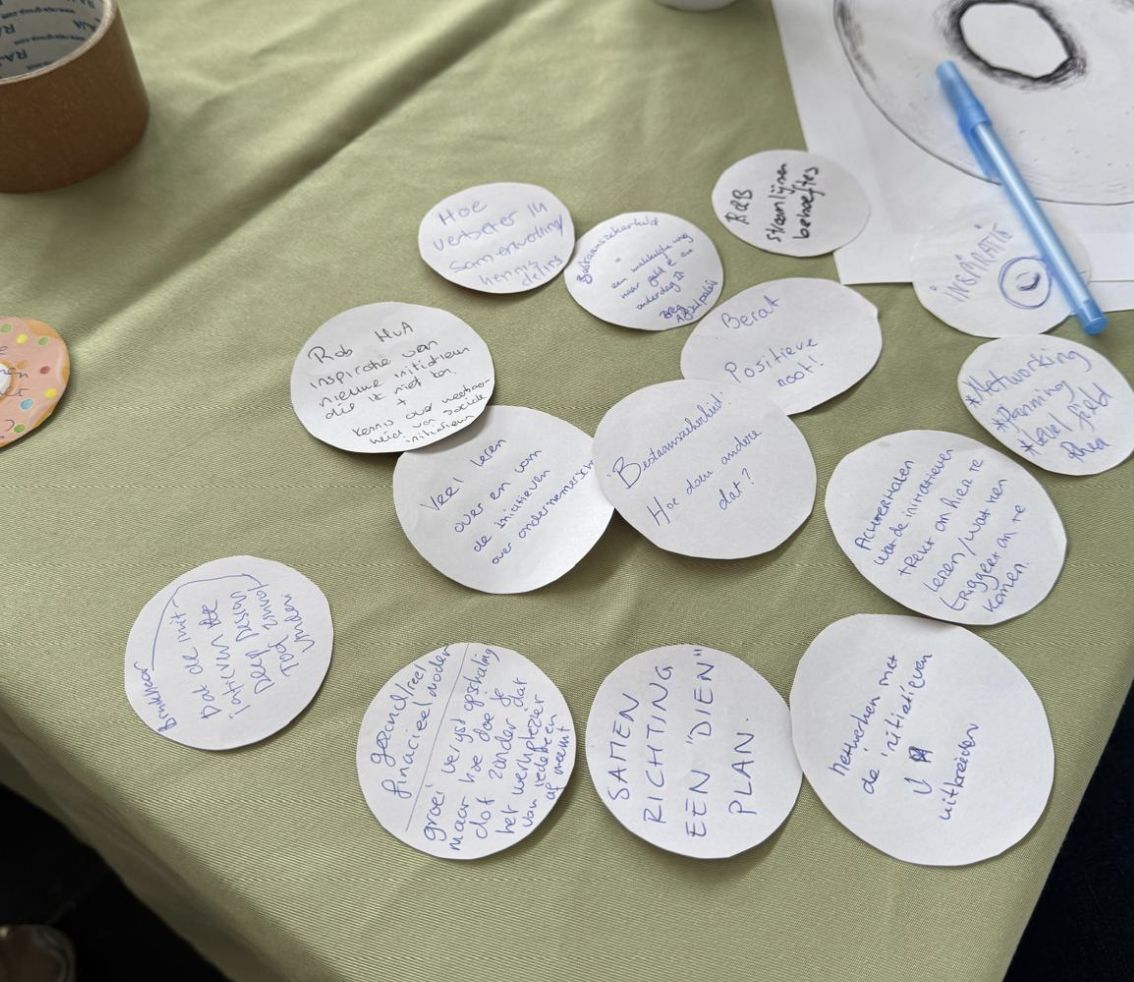
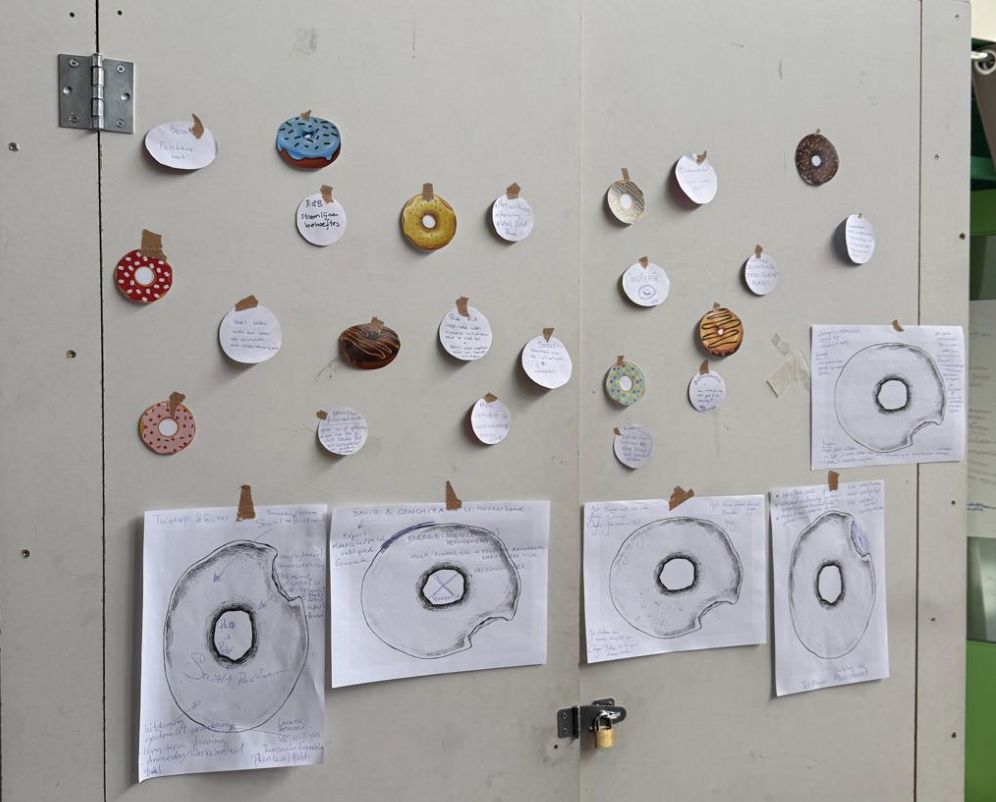
Design the format
- Check-in: “What do you hope to take home today?”
- Listening interview in pairs
- Check-out: “What are you taking with you?”
-
Agree on roles
The ADC recruits, we facilitate and evaluate, experienced pioneers bring practice, newer initiatives bring their questions.
-
Test it live
The format ran in the first Living Lab, with five initiatives from different sectors.
-
Evaluate and iterate
A 16-question survey, filled in by all five initiatives, and an evaluation with the ADC. Every answer became a design change.
(My role)
I designed the format, translating interview insights and learning theory into work forms, and was lead facilitator on the day. In the team I introduced Scrum and a shared planning board. Afterwards I set up the evaluation with the ADC and documented the format so they could run it without us.
(Voices)
From the interviews
In their own words.
Anonymous quotes from the pioneers we interviewed, translated from Dutch. Each one shaped a choice in the format.
Shared anonymously, with permission from the participants.
“The field is hugely fragmented. I hope the Donut Coalition can unite us better.”
“There isn’t really a place or a moment where everyone meets, so everyone just sits on their own little island.”
“I don’t want to come to a meeting and go home thinking: well, we talked a lot again and laid bare all the problems again. After that I really dropped out.”
“If we don’t make clear beforehand why we’re doing this, what we want to achieve and how, everything stays up in the air. Then everyone just talks.”
“I’m not someone who shares easily in a big group; I listen a lot. That’s why it’s nice to sometimes work in smaller groups.”
“The very small initiatives sometimes don’t even have a legal form, but they are super important. They just don’t have the capacity and time to work at city level.”
“Peer learning can work very well, but it takes time. To really learn, initiatives also have to find each other afterwards.”
(Findings)
What the research showed
Four reasons learning stayed scattered.
-
No structure yet
The Living Labs were still being built. Pioneers asked for a clear set-up, fixed work forms and a safe space to exchange experience.
-
Fragmented
Little knowledge moved between micro, meso and macro initiatives, and sectors mostly worked apart.
-
Unclear roles
The coalition’s role as facilitator of peer learning was not yet filled in. Without coordination, learning stays scattered.
-
No line to policy
What was learned was hardly recorded or connected to policy and funding, so valuable knowledge went unused.
Six recommendations
- A structured format with work forms for reflection, sharing experience and co-creation.
- The coalition as director of the learning process, with facilitators who keep it going.
- Deliberate connections between sectors and between levels.
- A digital place where what is learned is recorded and stays accessible.
- An evaluation and reporting format that links lessons to policy and funding.
- An implementation and evaluation plan with clear steps, goals and measuring moments.
(Conclusion)
What peer learning needs
Value, roles and a personal bond.
The research answered its main question with three building blocks. First, a workshop needs to make three kinds of value explicit: the value the Living Lab creates together (value creation), what each initiative uniquely adds to the network (value added), and what an initiative takes back from it (value captured). Naming these makes collaboration more transparent and builds trust (Teece, 2010; Adner, 2017; Osterwalder et al., 2014).
Second, who is in the room matters. The roles, backgrounds and expertise of participants shape the dynamics and build social capital, which grows through repeated interaction, shared norms and mutual trust (Bourdieu, 1986; Putnam, 2000). Trust grows when people feel seen and recognised, and that makes sharing knowledge on equal terms possible (Nonaka & Takeuchi, 1995).
Third, a Living Lab needs a social design, not just a technical or organisational one: shared learning goals, clear roles and expectations, and meaningful interaction between people from different sectors and levels of the system (Schuurman, 2015; Ballon, Pierson & Delaere, 2005). Only when value creation, clear roles and a personal bond between initiatives are built into the design does peer learning really improve.
(Impact)
Effects and risks
What could go right, and what could go wrong.
Expected effects
-
Better collaboration
Peer learning can break bottlenecks between sectors and levels, leading to more coherence and shared solutions.
-
Faster scaling
Initiatives grow faster by applying their peers’ lessons, instead of repeating the same mistakes.
-
Lasting knowledge
A structure for peer learning keeps knowledge in the network, even when people come and go.
-
More motivation
Pioneers feel more supported and connected, which can strengthen their commitment and perseverance.
Risks, and how to prevent them
-
People don’t join
Lack of time or priority keeps initiatives away. Low-threshold work forms and a clear answer to “what’s in it for me?” help.
-
Knowledge stays in small groups
Without feedback to the wider community, lessons get lost. A central place to record and share them prevents that.
-
Policy doesn’t pick it up
Involve policy makers from the start, and present results in accessible language with clear recommendations.
-
Funding stops
Many initiatives depend on temporary subsidies. Anchor peer learning in the coalition’s own structure and look for lasting funding.
The impact analysis led to a clear way of working: start with small pilots, evaluate in between, and scale up based on what works. That is exactly how the first Living Lab was set up.
(Decisions)
What shaped it
Small and playful, but strategic.
-
Lower the threshold
Icebreakers like “what’s your favourite donut?” made it possible to share real needs later in the day.
-
Design for unequal voices
Pairs and structured turns: newer initiatives were heard as much as established ones.
-
Make learning visible
Check-in and check-out gave participants a goal, and gave the ADC evidence of what was learned.
-
Hold on to what people need
Halfway, the client wanted an online platform. I argued to meet in person first. Afterwards participants asked for a digital space themselves.
(Outcome)
Results
Both work forms stay.
- Rated the session valuable
- 5/5
- Check-in and check-out
- 4.4
- Drawing exercise
- 4.0
- Got to know others better
- 4/5
- The ADC built both work forms into the Living Lab programme. The format is still in use.
- The ADC shared the format with Doughnut Economics Action Lab (DEAL), the international organisation that supports doughnut economics initiatives worldwide.
- Feedback led to changes: more time per exercise, matchmaking of help requests, a business perspective on revenue models, and a digital space between sessions.
(Reflection)
What I learned
Connection is not the same as collaboration.
Only 1 in 5 participants felt free to ask the others for help. People got to know each other, but that is not yet working together. The next iteration focuses on making help requests visible and matching people.
I also learned that building support does not always mean going along. Sometimes it means holding on to what works, as long as you can back it up, while keeping the relationship with the client intact.
(Sources)
APA 7
References.
- Adner, R. (2017). Ecosystem as structure: An actionable construct for strategy. Journal of Management, 43(1), 39–58. https://doi.org/10.1177/0149206316678451
- Ballon, P., Pierson, J., & Delaere, S. (2005). Test and experimentation platforms for broadband innovation: Examining European practice. In Proceedings of the 16th European Regional Conference of the International Telecommunications Society.
- Bergvall-Kåreborn, B., Ihlström Eriksson, C., Ståhlbröst, A., & Svensson, J. (2009). A milieu for innovation: Defining living labs. In Proceedings of the 2nd ISPIM Innovation Symposium (pp. 1–12).
- Bhatta, A., Vreugdenhil, H., & Slinger, J. (2025). Harvesting living labs outcomes through learning pathways. Current Research in Environmental Sustainability, 9, 100277. https://doi.org/10.1016/j.crsust.2024.100277
- Boud, D., Cohen, R., & Sampson, J. (Eds.). (2014). Peer learning in higher education: Learning from and with each other. Routledge.
- Bourdieu, P. (1986). The forms of capital. In J. Richardson (Ed.), Handbook of theory and research for the sociology of education (pp. 241–258). Greenwood.
- Edmondson, A. (1999). Psychological safety and learning behavior in work teams. Administrative Science Quarterly, 44(2), 350–383. https://doi.org/10.2307/2666999
- Hagy, S., Morrison, G. M., & Elfstrand, P. (2016). Co-creation in living labs. In W. Leal Filho & L. Brandli (Eds.), Engaging stakeholders in education for sustainable development at university level (pp. 169–178). Springer. https://doi.org/10.1007/978-3-319-33527-8_13
- Kolb, D. A. (2014). Experiential learning: Experience as the source of learning and development (2nd ed.). FT Press.
- Leminen, S., Westerlund, M., & Nyström, A.-G. (2012). Living labs as open-innovation networks. Technology Innovation Management Review, 2(9), 6–11.
- Mulgan, G. (2019). Social innovation: How societies find the power to change. Policy Press.
- Nonaka, I., & Takeuchi, H. (1995). The knowledge-creating company: How Japanese companies create the dynamics of innovation. Oxford University Press.
- Osterwalder, A., Pigneur, Y., Bernarda, G., Smith, A., & Papadakos, T. (2014). Value proposition design: How to create products and services customers want. Wiley.
- Putnam, R. D. (2000). Bowling alone: The collapse and revival of American community. Simon & Schuster.
- Raworth, K. (2017). Doughnut economics: Seven ways to think like a 21st-century economist. Chelsea Green Publishing.
- Schuurman, D. (2015). Bridging the gap between open and user innovation? Exploring the value of Living Labs as innovation intermediaries. Technology Innovation Management Review, 5(1), 8–16.
- Snowden, D. J., & Boone, M. E. (2007). A leader’s framework for decision making. Harvard Business Review, 85(11), 68–76.
- Ståhlbröst, A., & Holst, M. (2012). The living lab methodology handbook. Luleå University of Technology.
- Teece, D. J. (2010). Business models, business strategy and innovation. Long Range Planning, 43(2–3), 172–194. https://doi.org/10.1016/j.lrp.2009.07.003
- Wenger, E. (1998). Communities of practice: Learning, meaning, and identity. Cambridge University Press.